The Dutch Domestic Forces in Dordrecht.
On this page, you can find various items related to the Domestic Armed Forces ( Binnenlandse Strijdkrachten ) that do not fall under the categories of photos or documents.
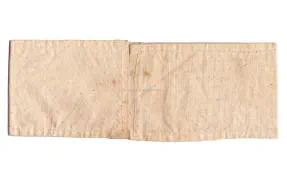
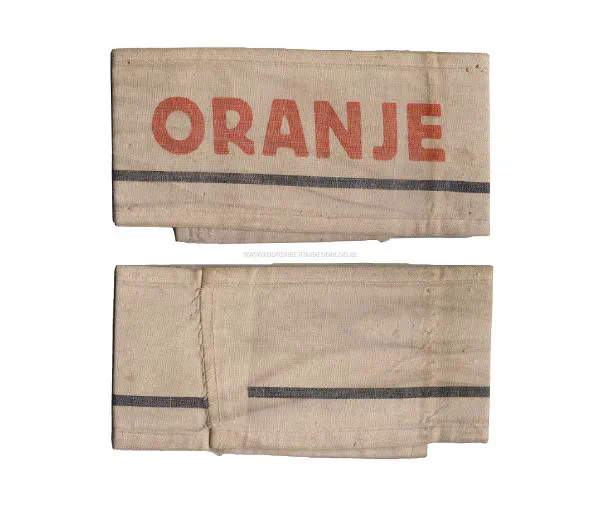
“Orange” Armband - Domestic Armed Forces Dordrecht
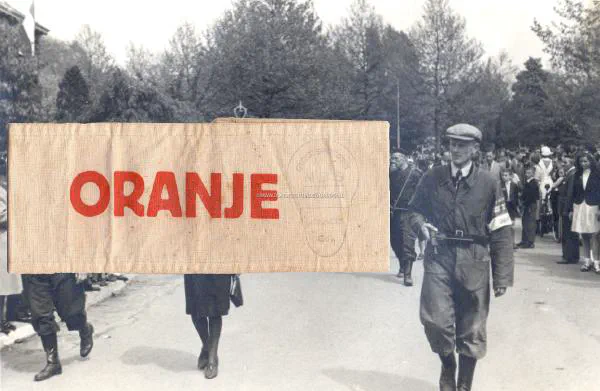
The armband in this photo belonged to a member of the Stoottroepen (Shock Troops) of the Domestic Armed Forces in Dordrecht. As seen in the photo above, the BS member in Dordrecht is wearing a similar type of armband on his left sleeve. The Domestic Armed Forces (BS) were established in September 1944 by Prince Bernhard. The BS served as an umbrella organization for all resistance groups present in the Netherlands at that time. Examples of these groups include the Ordedienst (OD), the Landelijke Knokploegen (LKP), and the Landelijke Organisatie voor hulp aan onderduikers (LO).
The development of these armbands began in September 1944. The initial design
featured an orange armband with black letters spelling “Oranje.” However, these
armbands fell into the hands of the Germans, leading the Allied High Command to
ban their use. This resulted in the need for new armbands. Consequently, various
types of armbands were encountered throughout the Netherlands among the Domestic
Armed Forces.
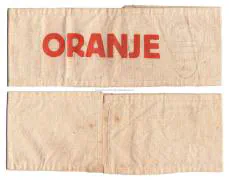
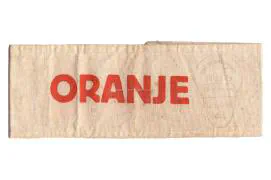
The armband you see here is an example of the type worn in Dordrecht during the
liberation. In this case, it is a white armband with orange letters spelling the
word “Oranje.” The word “Oranje” was required to be included on the armbands. On
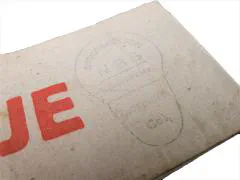
the stamp to the right, it reads: Stoottroepen NBS (Dutch Domestic Armed Forces)
- Dordrecht - District 5 Cdt (Commander). Below, you can view some more photos: (Click to enlarge)
Company Commander Combat Section Emblem Dordrecht
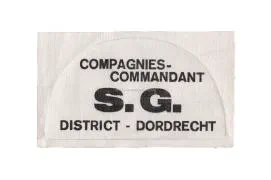
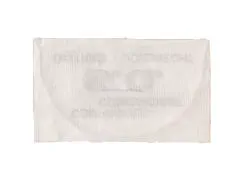
Below you can see a rare emblem of the Dordrecht Domestic Armed Forces. This emblem is specifically for a company commander of the Combat Section (S.G.). It was never officially issued, which is why it remains in excellent condition. The emblem was intended to be worn on the left sleeve from the wearer’s perspective.
There were different variations of emblems, including those for the Staff, Group Commander, and regular members. These emblems were hand-sewn onto the uniform, which often consisted of a blue overall. In some cases, it was regular civilian clothing.
“Orange” Armband Dordrecht
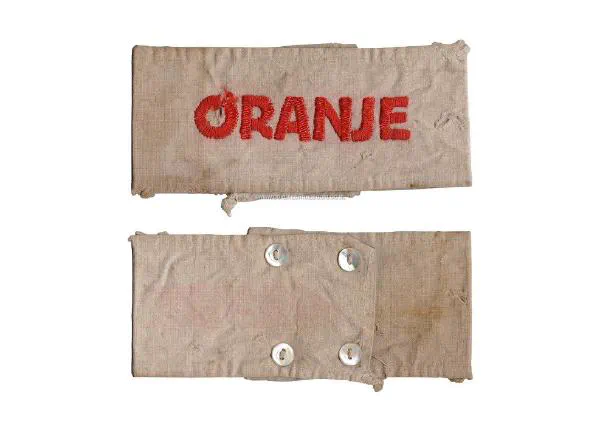
After previously adding one Orange Armband of the Domestic Armed Forces Dordrecht to the collection, we have now found a second one. This armband was worn by members of the Dutch Domestic Armed Forces in Dordrecht during the liberation of the city. This particular example features buttons and has an interesting detail: the word “Oranje” is embroidered over the printed text. This embroidery appears to be done by hand. The reason for this is unknown, but it was done periodically and executed very neatly. Perhaps someone wanted to practice their embroidery skills or it was done for a specific purpose. The armband shows signs of wear and tear and has witnessed the liberation of Dordrecht. Truly a unique piece of Dordrecht’s history!
Orange Armband Dordrecht - Section Commander
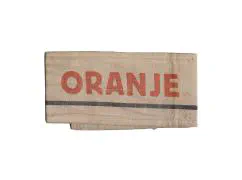
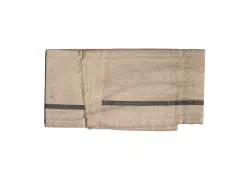
This armband, like the ones above, was used by members of the Domestic Armed Forces in Dordrecht. It is nearly the same model as seen above: a white armband with the word “ORANJE” in orange letters. The only difference is that the armbands above were intended for enlisted personnel, while this one is for a Section Commander. This is identified by the single black stripe on the armband. It is a very rare piece that is not often seen.
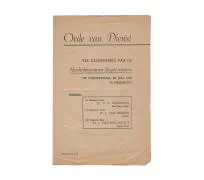
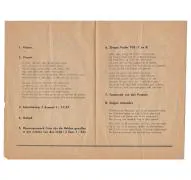
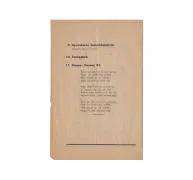
Order of Service – Commemoration of Illegal Workers in Zwijndrecht
This is the program for the commemoration of illegal workers on Thursday, July 26, 1945. The ceremony took place in Zwijndrecht, where during the war several resistance groups merged into the organization of the Domestic Armed Forces (Binnenlandse Strijdkrachten). These included the Ordedienst, Group Hein, LO/LKP, and the Geheime Dienst Nederland (GDN).
During the war, seven resistance fighters from Zwijndrecht lost their lives, most of them in various concentration camps. They were:
- G. Kögeler, died in Neuengamme concentration camp on January 2, 1945
- N. Rijsdijk, died in Amsterdam on July 31, 1942
- J. Slotboom, died in Neuengamme concentration camp on February 20, 1945
- F.M. Vogel, died in Vught concentration camp on August 9, 1944
- J.G. Vrolijk, died in Berlin-Tegel prison on June 4, 1943
- G.C. De Waard, died in Vught concentration camp on August 30, 1944
- T.A. Nawijn, died in Sachsenhausen concentration camp on January 14, 1945
*2